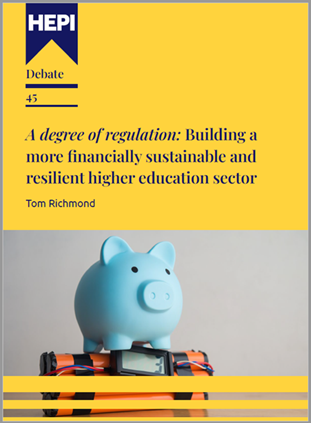
There is so much good work being done by so many higher education providers and academics to deliver a great experience to their students, yet this report outlines a range of evidence showing that some providers have taken too many risks, ignored students’ interests and damaged the reputation of the sector by pursuing extra tuition fee income above all else.
Given the pivotal role of higher education in our society and economy, it is legitimate for the Government to set new boundaries that aim to curtail excessive risk-taking while leaving the autonomy of many providers largely (if not entirely) intact. Consequently, this report describes a ‘toolkit’ of eight measures that the Government could implement to create a more financially sustainable and resilient higher education landscape in England. These measures, which could be introduced separately or as a full package, aim to put the interests of the sector and students above the interests of individual providers.
Protecting society’s interests
- Constraining provider growth: providers would be limited to 5 per cent annual growth in student numbers.
- Reducing the reliance on international students: the International Student Levy should only be charged on fees above the maximum tuition fee loan for domestic undergraduates and postgraduates.
- Restrictions on franchising arrangements: providers would require government approval for any franchising deal (including existing ones) and providers should be capped at receiving no more than 20 per cent of their income from franchising.
- Financial buffers to protect against losses: providers would be required to hold ‘capital buffers’, adhere to limits on debt levels and meet minimum liquidity requirements, as well as being subject to ‘stress tests’ to assess their financial resilience.
Protecting students’ interests
- A ‘teaching resource cap’ on the number of undergraduates that can be recruited: providers would be barred from accepting more undergraduates than they are able to support in terms of their overall teaching capacity.
- Ensuring providers have enough space for the students they enrol: providers would be made responsible for ensuring that any student who requires accommodation can secure a suitable living space within a very short travel distance of their place of learning, and every student on a course can be seated within a single venue (for example, a lecture hall) regardless of the course size.
- Transparency over the maximum number of students on every course: at the start of each application cycle, providers would be required to publish (and subsequently adhere to) the maximum number of students they will admit onto each course.
- Standardised degree classifications for providers: all providers would be limited to awarding 15 per cent of classifications as a ‘First’, 35 per cent of classifications as an ‘Upper Second’, 35 per cent as a ‘Lower Second’ and 15 per cent as a ‘Third’.
APRIL 2026
Times Higher Education – Cap student growth to curb ‘risky behaviour’, ministers told